
Cool Spot story
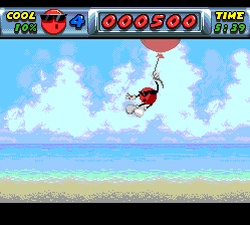
The red dot in shades has its own backstory—and it fizzes along like a soda dispenser by the shore. Cool Spot wasn’t cooked up by a focus group so much as bottled from real love for cartoony animation and those summer vibes: an ice-cold 7UP in hand, a little adventure in your head. 7UP’s mascot, Spot, spent years on posters and cans until Virgin Games said: let the logo hero step off the ad and prove he can carry a whole game. And just like that, Cool Spot was born—“Spot” to most of us, “the 7UP dot” to others—instantly recognizable from frame one: shorts, flip-flops, those signature sunglasses, and a personality that smiles with its eyes.
From ad mascot to a living character
The early ’90s were a time when product placement in games was still finding its balance. Virgin Games, already on a roll with punchy platformers, nailed the tone: not “ads for ads’ sake,” but a breezy adventure with its own identity. David Perry and the crew pushed toward one simple goal—give the dot weight, bounce, and charisma. Frame by frame they built a 16-bit platformer where animation isn’t garnish, it’s character: Spot slides, pops, dangles from a rope kicking his little legs, holds a beat—and you buy that he’s not a logo, but a tiny hero on a huge beach. On feel alone it plays less like a “brand game” and more like a sunlit story of freedom, spray, and springy steps across the pier planks.
In the West, the 1993 launch landed as a “mascot surprise”: nobody expected a promo icon to headline such a dialed-in platformer. From Amiga to Mega Drive/Genesis and Game Boy, the wave finally rolled onto Super Nintendo—where the SNES version cemented Cool Spot’s “game with a soul” rep. The visual language stayed the same: warm sandy hues, glittering sunlight, inflatable rings and plastic buckets turning into set pieces for a big adventure. The cartridge didn’t need many words—just vibes: you slot it in and the room suddenly smells like salt air and lemon-lime fizz.
Music that fizzes like the surf
To make the dot really sing, the team needed audio that didn’t just tap a beat—it nudged you forward: along the boardwalk, into the next leap. Tommy Tallarico’s soundtrack does exactly that—cartoony and cocky, grinning in the syncopation. It’s one of those OSTs that become identity. Two bars in and you’re on the shoreline, catching the groove and grinning back. No melodrama here—this score is about momentum over marathons: spring to a buoy, hop to a broken pier plank, scramble up the rope ladder. It plays like Spot himself is flicking you extra rhythm: one more, keep moving.
The box art and ads leaned into confident minimalism: the character up front, bottles faded in the back, the spotlight on effortless cool. It worked, everywhere. Back then “Cool Spot” spoke teen the same way across countries: chill, without the peacocking. Say “pop in the cart with the red 7UP dot in shades,” and everyone knew. Even the name “Spot” softened in speech—like he’d always been called that in your neighborhood.
How the dot rolled onto our shelves
Where we lived, Cool Spot reached players by all kinds of routes. Bootleg carts sat next to rare legit boxes, and the stickers ran the gamut: neat Latin Cool Spot or our homier transliterations. The label didn’t matter. The console chime, the logo—and suddenly you’re out among beach lanterns and timber walkways. Apartments echoed with the same refrain—“play some Spot,” “remember that 7UP dot with the shades?”—and that’s how the game traveled, hand to hand, with no need for big glossy reviews.
It may have started as a beverage-mascot project, but it stuck as a standalone because it simply felt great. People vibed with the pure genre joys: jump, explore, sniff out secrets. On SNES it felt especially mellow—like an evening cool-down after a hot day, a slow stroll down a familiar pier where the planks creak underfoot. No wonder a couple of years later the name returned in Spot Goes to Hollywood—the moment when “just a dot” fully graduated into a pop-culture character you could believe in even without a green label lurking in the background.
Say “Cool Spot SNES” today and muscle memory kicks in: a jump that lands on the bassline, flip-flops comically tapping the wood, soda bubbles twinkling in the animations, and a pause screen that feels like a tiny vacation invite. It’s that rare licensed tie-in that didn’t blur into the herd—it earned a reputation of its own. Virgin Games instinctively caught the formula: fewer logos, more personality.
And one little reason folks loved it—honesty. Cool Spot never tried to talk you out of finding joy in the simple stuff. No heavy drama, no fake heroics—just energy you can practically touch. Like being a kid: bottle of lemonade, straw between your teeth, sprinting toward the beach. At some point you catch yourself remembering not “the 7UP game,” but Spot himself—a small hero who’s easy to spend an evening with. Which is why he goes by many names—Spot, Cool Spot, “that 7UP dot”—because he feels like one of ours.
Years later the feeling still sticks: you plug in the cartridge, sunlight washes the screen, and you’re back on the shore. This beach doesn’t age. It lives in an OST that hushes like surf and in plush animation where every pause is a breath. Cool Spot never needed explanations or excuses. He showed up to set the mood—and stayed, on the shelf, in memory, in the casual “wanna boot up some Spot?”