
History
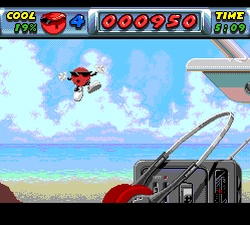
Cool Spot is that red dot in shades we all used to call “Cool Spot,” the 7UP red dot, the soda mascot—and yeah, he really is cool. From the first second it’s pure beach vibe: warm sand, the hush of waves, and a punchy tune that makes you want to bounce right along with him. On SNES it was that airy, springy platformer where every move feels like carving on a skateboard: silky animation, goofy poses, and that signature finger snap. It didn’t hook you with branding so much as with the feeling of summertime freedom: sprinting the shoreline, firing fizzy bubbles, springing off pier rats and bottle caps—and grinning the whole time. For a lot of us, Cool Spot became a little emblem of the 16-bit era: bright, rhythmic, light on words, but packed with a personality and style you can’t mistake.
Legend says a “just an ad” character turned into a game that stands on its own. Virgin Games pulled together a crew—Dave Perry included—and shipped a platformer that didn’t shy away from its roots yet played like a real adventure: grab Spots to fill the meter, race the timer, and at the goal free a buddy from a cage. Beaches, docks, toy-train rails, factory floors—the stages practically smell of lemon and sea salt. That cozy retro groove has long been filed in muscle memory: how the history fits together, why Tommy Tallarico’s music still loops in your head, and what made the product placement feel so ’90s—that’s exactly what the Cool Spot page nudges you to remember. For anyone slotting in the cartridge and chasing “one more level,” it’s a tiny vacation wrapped in pixels.
Gameplay

Cool Spot’s gameplay is a breezy rush. You’re the red dot in shades—the one and only Cool Spot—and everyday stuff suddenly turns gigantic: pier planks feel like avenues, bottles loom like skyscrapers. Movement has spring to it; your jump carries a touch of momentum, and those clicky shots spray in every direction. It’s not some dry arcade grind, it’s a dance: you snag gleaming Spots on the fly, pump up the Coolness percentage, weave past crabs and flies, and feel the timer gently nudge you forward. This platformer is all about tempo and flow: nail one clean run across ropes, buoys, and bathroom shelves and you slip into the zone, where the “7UP game” breathes like a summer stroll. Want the full breakdown? Dive in: gameplay.
Each stage is a timed escapade: reach the cage and free your Spot buddy. Hit the required percent and the lock pops; anything extra buys a shot at a bonus round—like a sip of ice-cold soda. It’s not just about sharp shooting and tidy jumps—you’ve got to read the terrain: sand drags, boards get slick, toy springs misbehave. Cool Spot rewards curiosity—secrets hide in cracks, under decking, behind bright signs; risk pays out with collectibles and extra lives. The difficulty scales honestly: first you learn to keep pace, then to meter your speed, catch the shot timing and the takeoff step. The sense of scale sells the fantasy: you’re a tiny red 7UP dot in a big world, and every ledge is a little reaction puzzle. When it all clicks, your hands find the rhythm—and you’re left with that sweet aftertaste that keeps you coming back to Cool Spot on SNES.